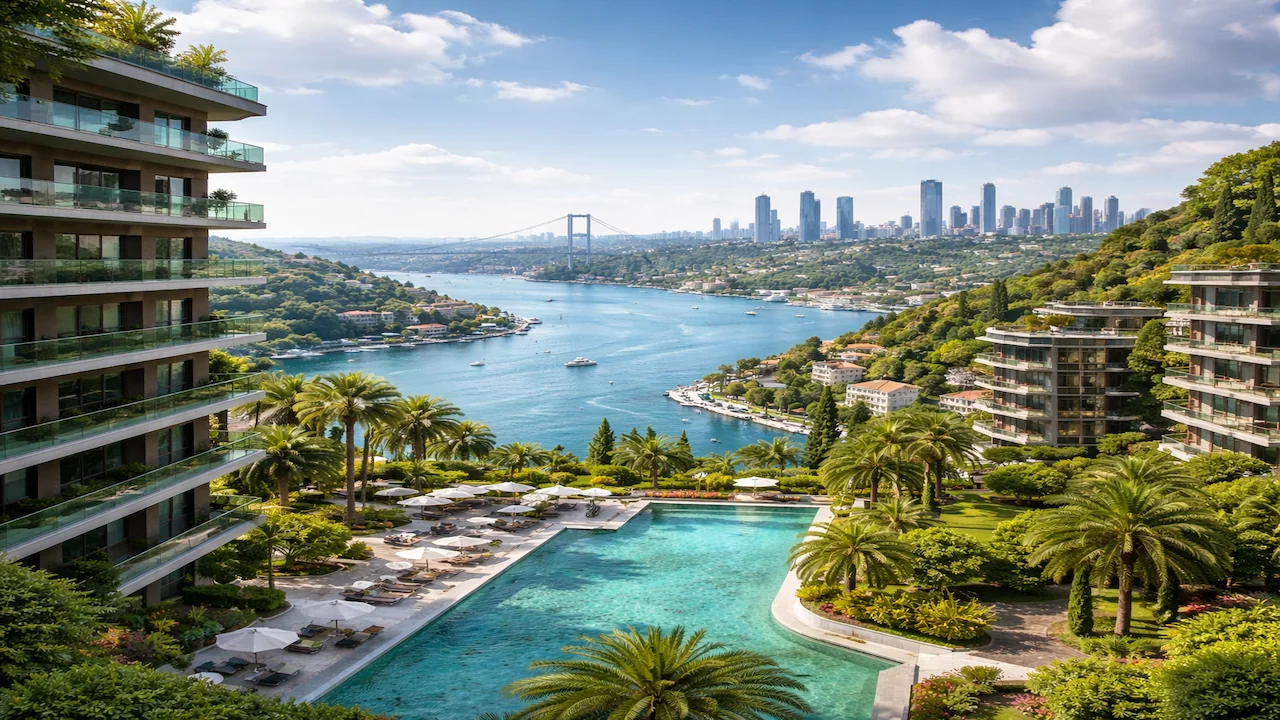
In recent years, Turkey has topped the list of prominent real estate investment destinations, not only due to its geographical location connecting East and West, but also because of its rapid economic, urban, and tourism developments. This makes it fertile ground for attracting investors from all over the world, especially those seeking a delicate balance between stable income and long-term capital growth.
But the picture isn't rosy for everyone... The smart investor is one who moves beyond merely buying an apartment for retention and delves into a deeper understanding of market dynamics: How does demand move? Which areas are experiencing a boom? And what are the real criteria that determine the success or failure of an investment? In this comprehensive guide, we will take you on a well-researched journey through Turkey's real estate map, revealing market secrets and outlining a realistic, actionable, and tangible return-generating investment plan with you.
Why is Turkey considered a real estate opportunity paradise for smart investors?
Real estate investment in Turkey is not solely based on superficial data such as apartment price or geographical location, but rather stems from deeper factors that shape market drivers and determine future returns.
Here are the reasons that make Turkey an attractive choice:
Diversity of the real estate market: From luxury apartments in the heart of Istanbul to coastal villas in Antalya, and commercial projects in Ankara, the Turkish market boasts a diversity that meets various goals and budgets. https://www.deal-tr.com/en https://www.mbany.com/en https://www.emlakplatform.com.tr/en
- Increasing local demand: Rapid population growth, internal migration, and urban expansion generate continuous local demand for rentals and housing.
- Active tourism market: Turkey is a global tourist destination, which means high seasonal rental opportunities in coastal cities.
- Government incentives: Citizenship by investment programs and reduced taxes for foreigners have made Turkey more attractive to foreign investors.
- Developed infrastructure: From metros to smart transportation, to modern airports, continuous infrastructure development enhances the value of surrounding properties.
- Therefore, Turkey is not just a place where you buy a property and wait for its price to rise; it is a dynamic, integrated market that enables you to build a smart strategy encompassing both stable income and capital growth simultaneously.
What are the real drivers of real estate demand in Turkey?
To thoroughly understand the Turkish real estate market, one must first identify the three demand patterns that drive investment:
- Local residential demand: A result of population growth and migration from rural areas to major cities.
- Investment demand: From local and international investors seeking rental yields or resale profits.
- Tourism demand: Short-term rentals, which are an increasing type, especially in coastal and tourist cities like Antalya, Fethiye, and Bodrum.
Choosing the area based on demand type
- In Istanbul, where there are business centers, universities, and public transport, long-term residential demand thrives.
- In Antalya and Bodrum, seasonal tourism demand is concentrated, offering quick profit opportunities during peak periods.
- In Ankara and Bursa, we find more stable and sustainable demand, especially from those working in the government or industrial sectors.
Therefore, it is not enough to ask "Where is the cheapest property?" The more important question is: "Where is there added value? And where do you expect future increases in demand and return?"
Flexible Entry Levels: How to Invest in Turkey According to Your Budget?
One of the most prominent advantages of real estate investment in Turkey is the possibility of gradual entry into the market:
- You can start with a small apartment for rent in an active area, testing the market before expanding.
- Or move towards urban development projects in growing areas, where prices are still reasonable and profit opportunities are high.
- Later, you can transition to investing in larger commercial or residential projects with higher returns and greater risk.
Step Investment
- Reducing risks through partial experimentation first.
- Improving your ability to gradually understand the local market.
- Expanding your real estate portfolio intelligently, according to the development of your experience and capital.
Thus, your decisions will not be random, but rather well-thought-out and cumulative, based on your actual experiences, not on marketing promises.
Istanbul: The Capital of Real Estate Opportunities and High Liquidity
Let's start with Turkey's most famous and vibrant city: Istanbul.
Why do investors prefer it?
- The largest labor market in the country: This means constant demand for rentals from employees, students, and families.
- Geographical and demographic diversity: Multiple neighborhoods with different living standards, from luxurious to middle-class.
- Massive infrastructure: Metro, highways, bridges, and future projects like the new airport and Istanbul Canal.
- High rental opportunities: Especially in areas near universities or financial centers.
Tips for successful investment in Istanbul:
Choose an area with constant demand, such as: Başakşehir, Kadıköy, Şişli, Beyoğlu.
- Look for modern residential projects with full services, which attract the modern tenant.
- Pay attention to the property's proximity to transportation, as this increases rental opportunities and speeds up resale.
Simply put, Istanbul is a city that guarantees you:
- Stable rental income
- Long-term capital growth
- Ease of exit and property sale when needed
But it also requires careful selection of the neighborhood and project, as not all that glitters is gold.
Ankara: A stable investment with a different style
Although Ankara, the political capital of Turkey, does not enjoy the same tourist fame as Istanbul or Antalya, it is an attractive option for investors seeking stability and investment security.
What distinguishes Ankara?
A strong presence of government jobs, as it is the center of ministries and embassies.
- A large number of universities and research centers, which creates a stable demand for rentals.
- Availability of integrated services in residential neighborhoods such as schools, hospitals, and shopping centers.
- Relatively lower prices than Istanbul, making it suitable for starting a medium-sized investment.
In Ankara, do not expect sudden price jumps, but rather profit from a stable rental yield and long-term stability. This makes it ideal for those who do not like market fluctuations or plan for a well-thought-out long-term rental.
Choose neighborhoods such as: Çayyolu, Batıkent, Altındağ, where quality blends with services and easy access.
Izmir and Bursa: Cities combining quality of life and investment return
Izmir
Izmir, the bride of the Aegean Sea, and one of the most attractive cities for those seeking a sophisticated lifestyle, and a mix of civilization and tranquility.
Advantages of investing in Izmir:
- A modern lifestyle that attracts families and professionals.
- Continuous development projects in neighborhoods like Karşıyaka and Bornova.
- Its proximity to the sea makes it suitable for long and short-term rentals.
- Slow but stable and promising real estate growth.
Bursa
As for Bursa, it represents a completely different destination, where industry and tourism meet in one city:
- The presence of major factories and industrial activities generates local demand for housing.
- Its green nature and proximity to Uludağ Mountain give it an attractive tourist dimension.
- An excellent transportation network connecting it to Istanbul by sea and roads.
- Golden opportunities in Bursa lie in investing near:
- Major industrial areas.
- Transportation hubs.
- Mountain tourist areas.
In short, Bursa achieves diversity in returns, while Izmir provides a stable environment suitable for investors who care about property quality and location without rushing profits for profits.
Antalya and coastal cities: Smart tourism investment
If your goal is to achieve quick and profitable rental income, then Antalya and the Turkish Riviera cities such as Fethiye, Marmaris, Alanya, are an excellent choice... but with a condition.
Pros:
- A long tourist season extending for more than 6 months.
- A continuous flow of European and Russian tourists.
- High potential to convert the property into a hotel apartment that generates daily returns.
Operational management requirements:
- Furnishing and equipping the property to the highest standards.
- Cooperation with rental platforms such as Airbnb or Booking.
- Providing services such as cleaning, reception, and maintenance.
The smart investor in Antalya does not buy an apartment by the sea and waits for a miracle, but rather manages an integrated project that transforms the property from a dormant asset into a strong daily income source.
Real estate investment strategies in Turkey according to objective
Not all investors are alike, and each objective has its own strategy, and here we explain how to choose your real estate investment style in Turkey:
1. Investment for rent: Semi-stable long-term income
If your primary goal is to achieve a regular monthly income, you are looking for:
- A property in a populated area close to universities or businesses.
- Ease of renting throughout the year.
- A stable rental yield, even if moderate.
- What are you looking for?
- Proximity to public transport and facilities.
- Excellent construction quality to reduce maintenance costs.
- An apartment with a size and design that suits a wide range of tenants.
You may not achieve immediate profits, but you build a continuous passive income and increase your financial stability year after year.
2. Investment for resale: Profit from urban transformation
If your goal is to make a profit from the price difference after the area's development, you are looking for:
- An emerging area undergoing infrastructure development projects.
- Indicators of population growth and urban movement.
- A low current price and a high future value.
Golden tip: Don't wait for a "boom," but analyze data and indicators with an investor's mindset:
- Has the government started expanding roads or the metro in this area?
- Are there school, university, or hospital projects under construction?
- Has the type of residents or the quality of residential projects changed recently?
All these are signs pointing to a promising area whose value will increase.
3. Commercial real estate: High returns for those with experience
Commercial real estate such as:
- Retail stores.
- Administrative offices.
- Medical and educational centers.
It often offers a higher return than residential property, but requires:
- Careful study of the location, population density, and demand.
- Assessment of tenant activity and financial stability.
- A strong and clear lease agreement.
Remember: Commercial property is not just a building, but a financial tool linked to cash flow. Tenant quality, contract duration, and type of activity are more important than tiles or paint.
How to choose the best real estate investment opportunity in Turkey? Criteria you should not ignore
Successful investment is not measured solely by the number of rooms or a beautiful view, but depends on a set of realistic indicators that determine whether the property will generate real returns or not.
Key criteria:
- Rental demand rate in the area
- Is the area active in terms of renting?
- What type of residents? Students? Employees? Families?
- Is there permanent or only seasonal demand?
Ease of access and transportation
- The property's proximity to the metro, metrobuses, or bus stations is a crucial factor.
- Properties linked to transportation hubs experience faster occupancy and higher prices.
Surrounding services
- Are there schools, hospitals, shopping centers, parks, or universities?
- The more surrounding services, the higher the rental and resale value of the property.
Building and finishing quality
- Good construction means a longer lifespan, less maintenance, and greater tenant attraction.
- Check the reputation of the construction company and its track record in previous projects.
Legal transparency and proper registration
Ensure that the property is officially registered and that it has no debts or legal restrictions.
Presence of nearby development projects
- Is a metro station being built nearby?
- Are there government plans to improve the area?
- Urban development gradually increases the property's value.
Golden rule: Don't be fooled by the price alone. A low price may hide operational problems, a poor location, or difficulty in reselling.
Legal costs and taxes in real estate investment in Turkey
It is a common mistake to calculate the return on property without including legal costs and taxes in the equation. Therefore, it is important to be fully aware of them before making a purchase decision.
Fees to know:
- Cost type: Property transfer tax (Tapu Tax)
Percentage / Value: 4% of the property value - Cost type: Legal consultation fees
Percentage / Value: Varies by lawyer - Cost type: Real estate appraisal fees
Percentage / Value: Between 300 to 1000 Lira - Cost type: Tapu registration fees
Percentage / Value: Between 200 to 500 Lira - Cost type: Document translation and notarization costs
Percentage / Value: According to the number of documents - Cost type: Annual maintenance fees (for complexes)
Percentage / Value: Depends on the services provided
Rental taxes:
If you rent out the property, you must declare the annual income and pay tax according to the category specified in the Turkish tax system. (Usually ranges from 15% to 35% depending on the bracket).
Important tip: Calculate the net return after deducting all these costs, not just the "advertised" return shown in marketing offers.
How to maximize the value of your property in Turkey? Secrets of successful investors
Investment does not end with buying the property. The most important part begins after the purchase: how to manage it? And how to increase its value?
1. Visually and functionally improve the property
- Furnishing the property elegantly and attractively speeds up renting.
- Choosing neutral colors and good lighting makes the tenant feel comfortable.
- Providing basic appliances (washing machine, refrigerator, air conditioner) increases its value.
2. Professional property management
- Regular maintenance preserves the quality of the property and extends its life.
- A tight and clear lease agreement reduces disputes.
- Documenting the property's condition with photos and videos provides proof when needed.
3. Carefully select tenants
- Check the tenant's background and ability to pay.
- Avoid random renting or to financially unstable segments.
4. Cooperate with reliable property management companies
- Especially if you are not a resident of Turkey.
- Their services include maintenance, collection, customer service, and bookings (for tourist properties).
5. Improve resale potential
- Keep all maintenance and improvement documents.
- Highlight the competitive features of the property when reselling.
- Monitor the market, and choose the timing of sale based on supply and demand indicators.
Conclusion: Is Turkey worth being your next real estate destination?
After reviewing all these aspects... The answer is: Yes, and strongly.
Turkey is not only a country with stunning nature and rich culture, but it is also a smart, expandable real estate market that offers options to suit all budgets, goals, and experience levels.
Whether you are looking for:
- Stable rental income,
- High capital growth opportunities,
- Profitable tourist investment,
- Or even a retirement plan and living in a safe environment...
The Turkish real estate market has something to offer you.
But remember:
Smart investment is not a coincidence, but a well-thought-out plan, decisions based on realistic indicators, and attention to operational, tax, and legal details.
Start small, test the market, then expand with confidence.