US Dollar - USD
- Turkish Lira - TRY
- US Dollar - USD
- Euro - EUR
- Pound sterling - GBP
- Russian Ruble - RUB
- Chinese Yuan - CNY
- Georgian lari - GEL
- Saudi Riyal - SAR
- UAE Dirham - AED
- Syrian Pound - SYP
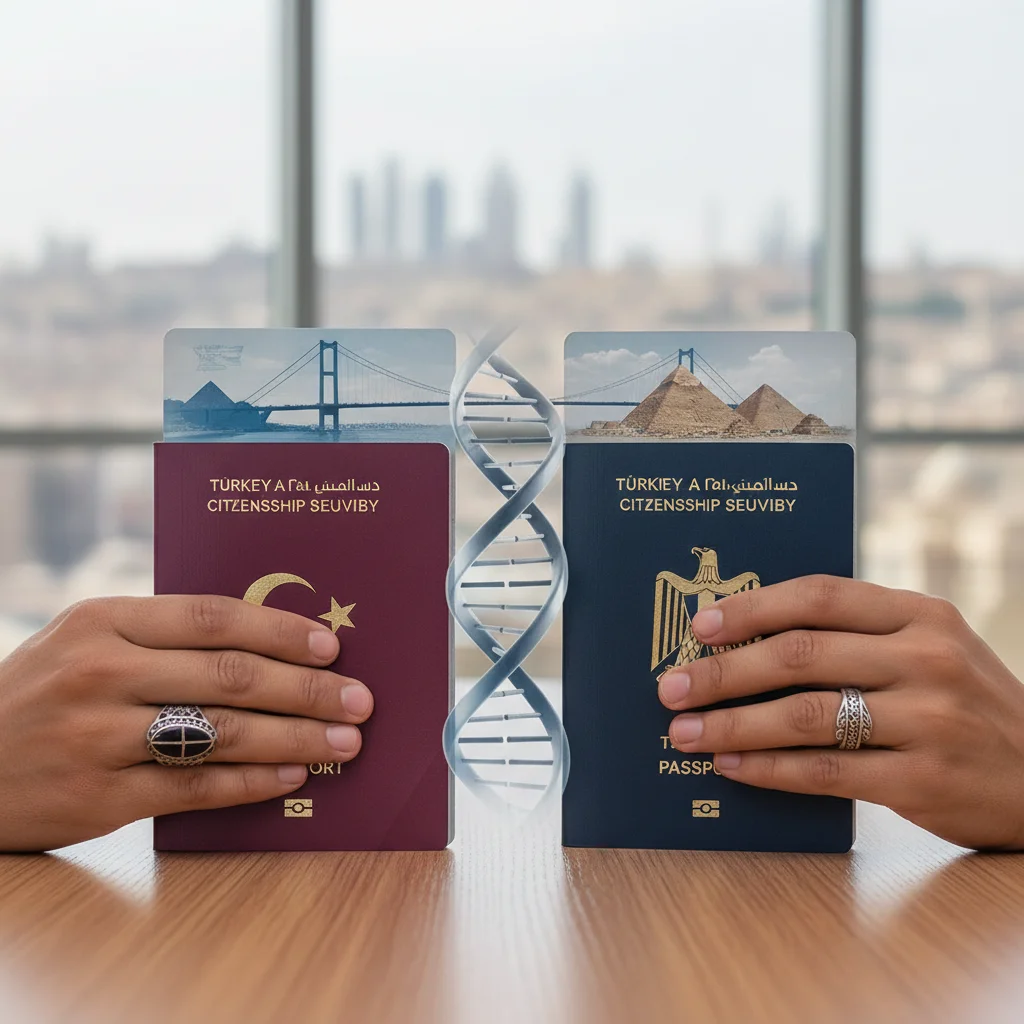
Interest in Turkish citizenship for Egyptians has grown steadily over the past decade, evolving from a lifestyle choice into a structured wealth-preservation and global-mobility strategy. In 2026, Turkey remains one of the most accessible destinations in the Mediterranean and Eurasian region for Egyptian families, entrepreneurs, and property investors seeking a second passport backed by tangible real estate assets. Strong cultural familiarity, frequent direct flights between Cairo, Alexandria, and Istanbul, and a transparent legal framework under Turkey's Citizenship by Investment program make the pathway practical when approached with proper due diligence.
Unlike programs built around non-refundable government donations, Turkey allows Egyptian buyers to acquire full nationality for themselves, their spouse, and their dependent children under 18 by purchasing qualifying real estate worth at least $400,000 USD. Investors retain ownership of their property, earn rental income during the mandatory holding period, and benefit from long-term capital growth in major Turkish urban markets. Navigating the process successfully, however, requires a clear understanding of Turkish land registry procedures, currency conversion regulations, residence permit rules, and Egyptian dual-nationality formalities.
For many Egyptian households, acquiring Turkish nationality is rarely about a single benefit. Instead, it addresses several practical priorities at once: diversifying family wealth into hard-currency-linked assets, expanding international travel freedom, securing educational and healthcare options abroad, and establishing a business base connecting Europe, the Middle East, and Central Asia.
When evaluating second-citizenship options, Egyptian investors frequently compare European golden visas, Caribbean passports, and regional residency programs against Turkey's offering. Turkey stands out because it grants full citizenship rather than temporary residency within a relatively short processing window, while keeping the capital invested in residential or commercial property.
One of the first legal questions Egyptian applicants ask is whether obtaining a Turkish passport affects their Egyptian nationality. Under Egypt's Nationality Law No. 26 of 1975, Egyptian citizens are permitted to hold dual citizenship, provided they follow official notification and approval procedures with the Egyptian Ministry of Interior (specifically the Passports, Immigration, and Nationality Administration).
Before or immediately after naturalization, Egyptian nationals must submit a formal request to acquire a foreign nationality while retaining Egyptian citizenship. Failing to obtain authorization can create administrative complications when renewing Egyptian identity documents or registering children later. Experienced legal advisors routinely coordinate both the Turkish filing and the Egyptian dual-nationality permit so that investors remain fully compliant in both jurisdictions.
Turkey introduced its Citizenship by Investment framework in 2017 and updated key thresholds in 2022. In 2026, the legal requirements remain clearly defined under the Regulation on the Implementation of the Turkish Citizenship Law. While real estate is overwhelmingly the most popular choice among Egyptian buyers, the law provides several parallel investment routes.
| Program Route (2026) | Minimum Capital | Holding Period | Primary Outcome | Suitability for Egyptian Investors |
|---|---|---|---|---|
| Real Estate Investment | $400,000 USD | 3 Years | Full Turkish Citizenship | Highest popularity due to rental yield and tangible asset control |
| Bank Deposit | $500,000 USD | 3 Years | Full Turkish Citizenship | Suitable for liquid investors preferring Turkish bank instruments |
| Fixed Capital Investment | $500,000 USD | 3 Years | Full Turkish Citizenship | Designed for corporate founders establishing industrial operations |
| Government Bonds or Funds | $500,000 USD | 3 Years | Full Turkish Citizenship | Used by portfolio investors focusing on REIF or VCI funds |
| Real Estate Residence Permit | $200,000 USD | As long as held | Renewable Residency (Ikamet) | Ideal for lower budgets seeking residency without immediate citizenship |
Understanding the distinction between the $200,000 residence permit route and the $400,000 citizenship route is critical. Since late 2023, Turkey raised the property valuation threshold for a real estate residence permit to $200,000 USD nationwide. Buying a property below $200,000 no longer qualifies for a property-based residence permit, and only properties valued at $400,000 or more unlock the fast-track citizenship program.
Egyptian nationals enjoy broad property ownership rights in Turkey. Following the 2012 amendment to Article 35 of the Turkish Land Registry Law, strict reciprocity barriers were lifted, allowing Egyptians to purchase residential and commercial real estate across Turkey subject to standard national limits—specifically a maximum of 30 hectares nationwide per foreign individual and no more than 10 percent of the privately owned land in any single district.
To qualify for Turkish citizenship by real estate investment in 2026, the cumulative value of the purchased property—or multiple properties—must equal at least $400,000 USD. Investors are not restricted to a single unit. You may purchase two apartments worth $210,000 and $195,000, or combine a residential flat with a commercial office, provided all purchases are structured correctly for citizenship eligibility.
There is, however, an important practical detail introduced under updated regulations: if you intend to use multiple properties under a notarized promise-to-sell contract (*Satış Vaadi Sözleşmesi*), the entire $400,000+ commitment should ideally be covered cleanly under compliant contracts and verified through official title deed or preliminary registration records. Splitting properties across unrelated developers or inconsistent payment dates can trigger delays at the Land Registry Directorate.
Every qualifying title deed (*Tapu*) or notarized sales promise contract must carry an official legal annotation (*Şerh*) stating that the owner will not sell or transfer the property for three years from the date of registration. This three-year lock-in period is strictly monitored by the General Directorate of Land Registry and Cadastre (*Tapu ve Kadastro Genel Müdürlüğü*).
During those 36 months, you retain full ownership rights. You may live in the property, leave it vacant as a holiday home, or lease it out to long-term tenants for steady rental income. Once the three-year anniversary passes, the restriction may be lifted, allowing you to sell the property on the open market—including to another foreign buyer—without losing your Turkish citizenship.
Not every $400,000 property on the Turkish market qualifies for citizenship. Several strict legal filters determine whether a unit will pass compliance review.
Investors can choose either ready-to-move-in properties with an existing title deed or under-construction projects backed by a notarized promise-to-sell agreement. For completed units, verifying the habitation license (*İskan*) and condominium ownership status (*Kat Mülkiyeti* or *Kat İrtifakı*) is essential. For off-plan properties, the full $400,000 purchase amount must be paid upfront through bank transfers, and the notarized contract must be annotated directly at the Land Registry.
Under Turkish Central Bank directives, foreign real estate buyers must convert their foreign currency (such as USD or EUR) into Turkish Lira through a licensed Turkish bank prior to title deed transfer. The bank sells the foreign currency to the Central Bank of the Republic of Turkey and issues a Foreign Exchange Purchase Certificate known as the *Döviz Alım Belgesi* (DAB). Without this certificate matching the declared sales price, the Land Registry will not process the purchase.
Additionally, every dollar of the purchase price must move transparently through the banking system from the buyer's account to the seller's account, accompanied by stamped bank receipts (*Dekont*). Cash payments or informal handovers are disqualified from citizenship applications.
Every citizenship-linked acquisition requires an independent real estate appraisal report prepared by a valuation company licensed by the Capital Markets Board of Turkey (SPK) and assigned through the official state valuation system. The appraised market value—not just the developer's asking price—must reach or exceed $400,000 USD. Furthermore, the property cannot be bought from another foreign individual or from a Turkish company owned by foreign shareholders if that property was previously used to obtain Turkish citizenship.
Looking for the best real estate investment opportunity in Istanbul?
We help you choose the right property based on your budget and goals
Get a Free Consultation
Buying property in Turkey as an Egyptian national can be completed in person during a short visit to Istanbul or remotely via a notarized Power of Attorney granted at the Turkish Embassy in Cairo or the Consulate General in Alexandria. Following a structured sequence helps avoid banking bottlenecks and documentation rejections.
Document preparation is often the stage where timelines stretch if Egyptian civil records lack proper legalization. All Egyptian birth certificates, marriage certificates, and family registry extracts must be translated into Turkish, notarized, and authenticated by the Egyptian Ministry of Foreign Affairs and the Turkish Embassy in Cairo (or Consulate in Alexandria), as Egypt is not a party to the Hague Apostille Convention.
| Stage | Estimated Timeframe | Key Documents Required |
|---|---|---|
| Property Search and Legal Verification | 1 to 2 Weeks | Passport copy, preliminary sales agreement, Tapu copy |
| Tax Number, Bank Setup, and DAB | 1 Week | Passport, Turkish tax ID, Egyptian address proof, bank KYC forms |
| Valuation and Title Deed Transfer | 1 to 2 Weeks | SPK valuation report, DAB, DASK insurance, bank receipts |
| Certificate of Conformity | 2 to 4 Weeks | Annotated Tapu, official payment proofs, DAB |
| Investor Residency and Citizenship Approval | 4 to 6 Months | Legalized Egyptian birth/marriage certificates, biometric photos, criminal record check |
Selecting the right location determines both your rental yield during the three-year holding period and your exit liquidity once you are free to sell. Egyptian buyers tend to favor established metropolitan hubs where infrastructure, international schooling, and tenant demand remain consistently strong.
Istanbul absorbs the majority of foreign property investment in Turkey because it combines deep local tenant demand with strong resale liquidity. Different districts serve distinct investment strategies:
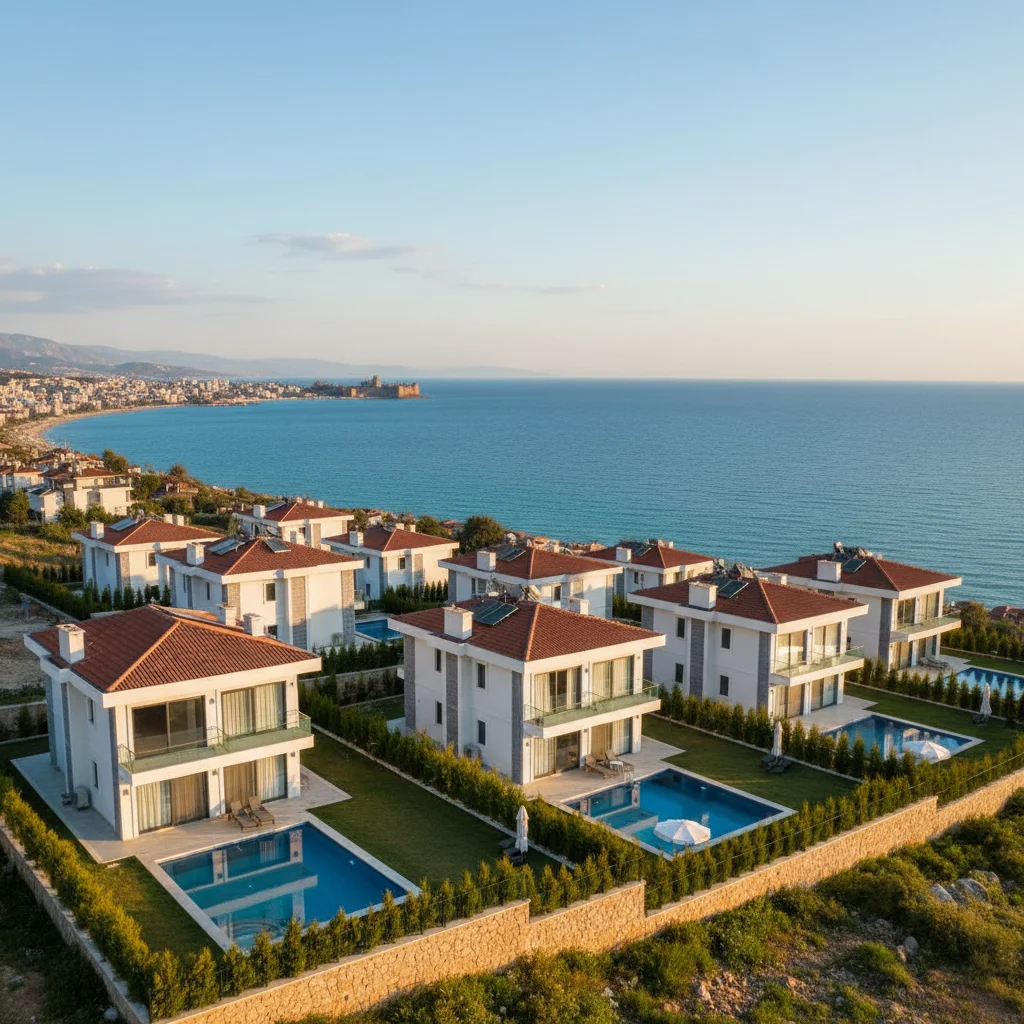
Beyond Istanbul, several regional cities appeal to investors with specific goals. Antalya attracts buyers seeking Mediterranean coastal villas and high seasonal demand, though short-term rental rules now require licensing. Ankara offers steady institutional and diplomatic tenant demand around Çankaya with lower price volatility. Bursa remains popular among families seeking greenery, calmer urban living, and quick ferry or highway access back to Istanbul.
| City / District | Primary Investor Profile | Demand Driver | Typical Exit Liquidity |
|---|---|---|---|
| Istanbul (Başakşehir) | Relocating families | Modern compounds, schools, healthcare hubs | High |
| Istanbul (Şişli / Kağıthane) | Yield-focused investors | Corporate offices, metro lines, urban renewal | Very High |
| Istanbul (Ataşehir / Kadıköy) | Long-term wealth preservation | Financial Center, affluent local demand | Very High |
| Antalya (Konyaaltı / Lara) | Lifestyle and holiday buyers | Coastal living, international expat community | Moderate to High |
| Ankara (Çankaya) | Conservative income buyers | Government, embassies, university tenants | Moderate |
Many Egyptian buyers explore Turkish residency before committing $400,000 to citizenship, or need clarity on how residence permits work for extended family members such as adult children over 18 or elderly parents.
If an investor purchases a residential property with an official valuation of at least $200,000 USD, they qualify for a renewable short-term real estate residence permit (*Taşınmaz Amaçlı İkamet İzni*). This permit allows the owner, their spouse, and minor children to live legally in Turkey, open local accounts, and enroll children in schools. However, it does not grant immediate citizenship; standard residency leads to naturalization eligibility only after five continuous years of physical residence in Turkey with strict limits on days spent abroad.
A crucial distinction separates residency permits from citizenship purchases. Turkey restricts new residence permit registrations in over 1,100 neighborhoods nationwide where the foreign population exceeds 20 percent of total residents (including several popular areas in Fatih, Esenyurt, Küçükçekmece, and parts of Antalya). Buying a property in a closed neighborhood can block a first-time *ikamet* application under the $200,000 route. By contrast, purchasing a $400,000+ property for Turkish citizenship by investment uses the dedicated investor residency channel and is not blocked by neighborhood closure rules for citizenship purposes, though buyers intending to live in a specific district should verify local address registration rules beforehand.
Citizenship applicants obtain a specialized short-term Investor Residence Permit under Article 31(j) of the Law on Foreigners and International Protection. Unlike standard residency applications, only the main applicant needs to hold this permit as a procedural bridge while the citizenship file undergoes security and background review, and the applicant does not need to reside in Turkey while waiting for final approval.
Looking for the best real estate investment opportunity in Istanbul?
We help you choose the right property based on your budget and goals
Get a Free Consultation
Budgeting solely for the $400,000 property price is a common mistake. Egyptian buyers should set aside an additional 6 to 8 percent of the property value to cover transaction taxes, mandatory insurances, translation and legalization costs, and legal representation.
| Expense Category | Typical Rate or Range (2026) | Frequency | Notes |
|---|---|---|---|
| Title Deed Transfer Tax (Tapu Harcı) | 4% of declared value | One-time | Legally split 2% buyer and 2% seller, though buyers often negotiate or pay 4% |
| Title Deed Revolving Fund Fee (Döner Sermaye) | Approx. $150 to $350 USD | One-time | Fixed municipal and registry administrative tariff |
| SPK Valuation Report | Approx. $350 to $600 USD | One-time | Mandatory independent appraisal for citizenship |
| Legal, Translation, and Notary Fees | $3,000 to $6,000 USD | One-time | Covers POA, Egyptian document legalization, conformity and citizenship filings |
| DASK Earthquake Insurance | Approx. $50 to $150 USD | Annual | Mandatory before Tapu transfer and utility connections |
| Annual Property Tax (Emlak Vergisi) | 0.2% (metropolitan) / 0.1% (standard) | Annual | 0.4% for commercial properties in metropolitan municipalities |
| Monthly Maintenance Fee (Aidat) | $40 to $250+ USD | Monthly | Varies by compound amenities, security, pools, and heating systems |
Note also Turkey's Value Added Tax (VAT) rules on newly built properties. While standard VAT ranges between 10 percent and 20 percent depending on property classification, foreign individuals without residence in Turkey may qualify for a VAT exemption on their first newly built purchase from a developer, provided foreign currency is brought into Turkey from abroad and the property is held for at least three years (matching the citizenship holding period). Confirming VAT exemption eligibility before signing a developer contract can save tens of thousands of dollars.
Once the title deed is registered and your citizenship file is underway, turning your Turkish real estate into a well-managed income asset ensures the investment works productively throughout the three-year lock-in period and beyond.
In 2024, Turkey implemented Law No. 7464 strictly regulating short-term rentals of fewer than 100 days (such as Airbnb-style holiday lets). Operating a short-term tourist rental now requires a Ministry of Culture and Tourism permit and unanimous written consent from all unit owners in the apartment building. Unauthorized short-term leasing carries heavy administrative fines.
Consequently, most Egyptian investors favor standard annual residential leases of one year or longer, which remain straightforward, require no tourism license, and benefit from strong urban housing demand. Under Turkish tenancy law, annual rent increases for residential contracts are governed by official Consumer Price Index (TÜFE) 12-month averages, providing inflation-linked adjustment mechanisms.
For Egyptian owners living in Cairo, Riyadh, or Dubai, remote self-management is rarely practical. Reputable Turkish property management firms handle tenant screening, notarized lease drafting, utility transfers, *Aidat* tracking, routine maintenance, and annual Turkish rental income tax declarations. Before appointing a manager, ensure your contract specifies transparent fee structures—typically 8 to 12 percent of collected annual rent—alongside regular financial statements and owner approval thresholds for repairs.
Preserving resale value starts with asset care and tax compliance. Keep annual property tax (*Emlak Vergisi*) receipts and rental income tax filings organized. When selling after five years of ownership, individual property owners in Turkey are generally exempt from capital gains tax (*Değer Artış Kazancı Vergisi*), whereas selling between year three and year five may trigger tax on inflation-adjusted profits. Planning your exit horizon around both the three-year citizenship rule and the five-year capital gains exemption maximizes net returns.
Although Turkey's property market is well regulated, rushed decisions or reliance on unverified intermediaries can jeopardize a citizenship application.
Yes. You can execute a specific Power of Attorney (POA) in favor of a trusted Turkish real estate lawyer at the Turkish Embassy in Cairo or the Turkish Consulate General in Alexandria. Your lawyer can then obtain your tax number, open accounts where permitted, sign the title deed transfer, and submit the citizenship application on your behalf.
From completing the title deed transfer and securing the Certificate of Conformity, the citizenship review and security clearance typically take between four and six months, assuming all Egyptian civil documents are properly translated and legalized without errors.
No. Turkish Citizenship by Investment covers only the main investor, one spouse, and dependent children under the age of 18 at the date of application. Adult children over 18 and parents cannot be naturalized under the same file, though they may apply separately for standard residence permits or their own investments.
No. The legal holding requirement is three years from the date the non-sale annotation is placed on the title deed or notarized promise-to-sell contract. After three years, you may sell the property and keep your Turkish citizenship permanently.
Yes. Net rental income above Turkey's annual statutory residential exemption threshold is declared each March and taxed on a progressive scale. Working with a Turkish certified public accountant ensures deductions for maintenance, depreciation, or management expenses are properly applied.
Securing Turkish citizenship for Egyptians through real estate remains one of the most balanced investment-migration strategies available in 2026. When structured around verified SPK valuations, transparent bank transfers, prime urban districts, and sound property management, a $400,000 real estate portfolio delivers both a resilient hard asset and lifelong citizenship for the next generation. Taking time to verify legal compliance at each stage—from Cairo document authentication to Istanbul title deed registration—ensures a smooth transition from property buyer to Turkish citizen.
Note: The information in this article was sourced from Emlak Platform, Mbany Real Estate, and Massar Istanbul.